
How to Get the Right Headshot Dimensions and Ratios
Learn the best headshot dimensions, aspect ratios, and cropping guidelines that you can use for LinkedIn, acting, corporate, or website headshots.

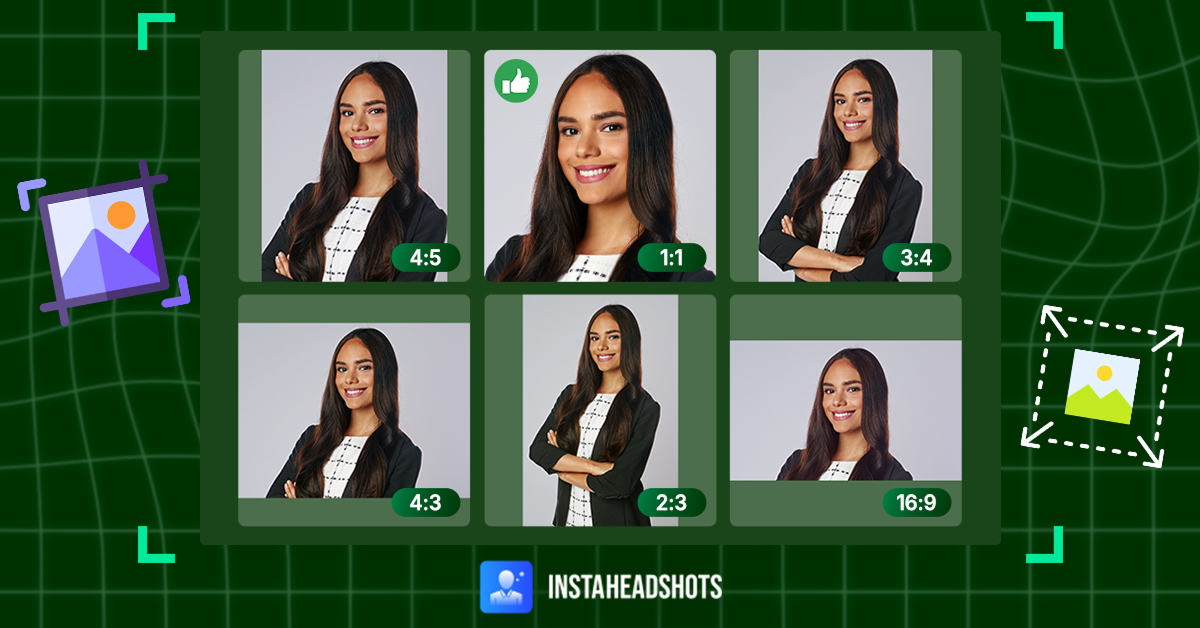
Learn how to nail headshot dimensions across platforms by challenging outdated rules and avoiding common pitfalls.
If you’ve ever uploaded a picture-perfect headshot only to see it clipped on LinkedIn—hairline trimmed, shoulders gone—you already know how unreliable generic sizing advice can be. When a professional headshot is often your first impression, small cropping or resizing errors can quickly affect how credible you appear.
Most guidance focuses on rigid dimensions or file size recommendations, without explaining when each actually applies. The result is confusion, inconsistent framing, and images that look fine in one place but off everywhere else.
The real issue isn’t the size or resolution. It’s how your headshot is framed, cropped, and displayed on different screens. Those choices shape how clearly your face shows up and how you come across before anyone reads a word of your bio.
At InstaHeadshots, we focus on the details that matter when images are resized or cropped: natural skin texture, accurate hair shape, clean edges, and true-to-life lighting. Those details help images hold their shape and clarity when resized for various platforms, avoiding the stretched or overly processed look common in many AI tools.
TL;DR: There’s no single standard headshot dimension. The right size depends on where the image appears and how it’s viewed. Square (1:1) ratios are common for digital directories like LinkedIn, 4:5 works well for corporate teams and actor submissions, and 2:3 is often used for ID photos and badges. Starting with a realistic, high-detail image makes resizing and reuse more predictable. InstaHeadshots generates natural-looking photos in multiple ratios, so your headshot retains accurate proportions and clear detail wherever it’s used.
What are standard headshot dimensions?
“Standard” headshot dimensions aren’t universal. The right professional headshot size depends on who’s viewing the image and where it appears. Generic sizing advice often conflicts because it ignores context. For example, a physician’s LinkedIn profile photo has very different size requirements than a model’s printed audition shot.
For better results, choose dimensions based on industry standards and how the image will be used:
- Actors: Print headshots are typically 8x10 inches, while digital submissions commonly use a 4:5 ratio.
- Corporate teams: Most companies rely on 1:1 or 4:5 ratios, depending on brand guidelines and layout needs.
- Healthcare professionals: Square formats work well for portrait-style directories and profiles, often around 800x800 pixels.
- Advisers: Realtors, coaches, and personal trainers frequently use 4:5 for digital platforms and 5:7 for print materials.
It can be tempting to upload a large image and let the platform handle the rest, but most crop based on shape, not file size. Without selecting the right ratio and pixel dimensions up front, important details like your hairline or chin can be cut off before anyone ever sees your full photo.
Aspect ratios explained
An aspect ratio describes the relationship between a photo’s height and width. More than simple framing, it determines how a headshot displays across different screens and layouts, and whether important details stay visible after upload:
- 1:1 (square): Easy to crop and widely supported across digital platforms, including LinkedIn, Slack, and Gmail.
- 4:5: A balanced portrait that allows more room for facial detail. Commonly used for actor headshots, brochures, and professional applications such as ERAS.
- 2:3: A narrower portrait ratio that works well for tight layouts, including ID photos, clip-on badges, and resumes.
Many platforms apply their own cropping rules based on layout and display constraints. Starting with the correct aspect ratio helps prevent unwanted trimming around the shoulders or face and keeps your headshot looking consistent across uses.
InstaHeadshots generates realistic, professional headshots in multiple aspect ratios, so images hold their framing when reused in different layouts.
Print vs. digital headshot sizes
The best headshot size depends on where the image appears. Print and digital formats handle resolution, cropping, and compression very differently, which is why the same photo can perform well in one place and poorly in another.
On digital platforms, high-resolution files can work against you. Oversized images are often compressed automatically, which can introduce blur or unexpected cropping, particularly on smaller screens.
Still confused? Check out more tips on sizing and resolution.
Pixel dimensions for common platforms
Pixel dimensions affect how clearly your headshot photo renders on different screens. When the size matches the platform’s requirements, facial details stay sharp, and proportions remain intact, both of which support a more credible and lasting impression.
Problems arise when images don’t align with how platforms process uploads. Files that are too large are often compressed automatically, while mismatched dimensions can trigger cropping or scaling that distorts facial features. That’s why bigger files don’t always produce better results, especially when images are viewed on mobile or older devices.
Common pixel sizes by platform include:
- LinkedIn: 400x400 px (profile), 1584x396 px (banner)
- Instagram: 320x320 px (profile), 1080x1080 px (posts)
- Facebook: 170x170 px to 360x360 px (profile), 1200x628 px (posts)
- Gmail: 180x180 px (profile)
- Professional applications: 375x525 px
- Print marketing: 300 DPI (dots per inch)
Choosing pixel dimensions with the audience in mind helps prevent compression artifacts and uneven crops. For example, a realtor updating an MLS profile may prioritize higher-resolution images to maintain clarity on larger displays, while still staying within platform guidelines.
How to crop a headshot
Whether your headshot appears in professional networking settings or alongside a casting call, cropping plays a quiet but important role in how you’re perceived. It signals care, intention, and attention to detail before anyone reads your name or title.
Headshot photographers generally recommend the following guidelines for effective cropping:
- Follow the rule of thirds by keeping your eyes in the upper third of the frame.
- Aim for your face to fill roughly 60–70% of the image.
- Leave space around the hairline unless tight framing is required.
- Avoid cutting off the chin, especially with 1:1 square crops.
- Use a slightly tighter crop for actor headshots.
- Include shoulders for more conservative industries, such as healthcare.
A well-cropped photo directs attention where it belongs. Instead of noticing uneven edges or awkward framing, viewers focus on your expression and presence—the cues that shape trust and recognition at first glance.
Vertical vs. horizontal orientation
As with aspect ratios and pixels, orientation depends on context. An actor may choose a vertical crop to support casting requirements, while a corporate team often prefers horizontal framing to suit modern web layouts and bio pages.
Portrait-oriented images typically anchor well within square frames (1:1), while horizontal crops (4:5) offer flexibility for wider layouts. For example, a tech startup founder might use a horizontal headshot with intentional negative space to support a clean website design or executive profile.
These guidelines aren’t absolute. In some cases, a square crop may still perform better than a wide one, even when the source image is horizontal. Comparing orientations helps ensure your headshot holds up across different platforms without awkward framing or visual imbalance.
InstaHeadshots provides multiple orientations using consistent, high-detail source images, so you can compare formats and choose what fits each use case best.
How to resize a headshot without losing quality
Resizing a headshot isn’t just about shrinking a file to fit a platform. The choices you make before and during resizing—image quality, proportions, and compression—determine whether facial details stay intact or degrade.
To resize without sacrificing clarity:
- Start with a detailed image: Choose a high-definition photo with clean edges and visual texture. Strong details at the start help preserve features like skin texture and hair shape after resizing.
- Lock your aspect ratio: Maintaining the original ratio prevents distortion and avoids squashing or stretching facial features.
- Use high-quality compression: Trusted tools like Photoshop or Canva compress images more predictably, helping retain sharpness, especially for more narrow formats like 2:3 headshots used on business cards.
Choose the right ratio for your professional headshots
The way a headshot is sized and framed influences how accurately it represents you in different contexts. Selecting the right ratio helps preserve facial proportions, maintain consistent framing, and avoid visual distractions—whether the image appears on a screen or in print.
Starting with a realistic, high-detail image gives you more control over how your headshot holds up. InstaHeadshots generates professional photos with natural skin texture, accurate hair detail, and clean edges, then delivers them in multiple orientations and ratios. That flexibility allows you to select the right format for each use with confidence.
Ready to stop resizing, recropping, and second-guessing? Create your professional image with InstaHeadshots today—no studio required.
FAQs
What is the standard size for a professional headshot?There isn’t a single standard headshot size. Acting headshots are typically 8x10 inches for print, while corporate headshots and digital platforms commonly use square or 4:5 ratios.
What pixel size should I use for LinkedIn?A 400x400 px square image delivers the most consistent results for profile photos.
Should I crop differently for print vs. online?Yes. Print headshots usually include more shoulder space, while digital images tend to look best when the face fills about 60–70% of the frame.
How do I avoid blurry headshots?Start with a realistic, high-quality image and keep the aspect ratio locked when resizing. Avoid aggressive compression, which can soften detail.
Does orientation matter?Yes. Actors typically use vertical crops for submissions, while corporate teams may choose horizontal formats based on website or layout needs.