
What to Wear for Your ERAS Photo: A Practical Guide
There's no official AAMC dress code for your ERAS photo. Here's what to wear, what to avoid, and how to look professional at thumbnail scale in 2026.

I kept hearing the same question from applicants: "Is there a correct outfit for the ERAS photo?" Everyone had an opinion. Nobody could point to a rule.
So I went looking for the rule. I read the AAMC's own pages, ten career-office and studio guides, forum threads, and a bias study on resident selection. What I found surprised me. There is no official AAMC dress code. The "suit rule" everyone repeats came from photographers and career offices, not the AAMC.
You are stressed, short on time, and getting conflicting advice. I get it. This is a small decision that feels large because it is hard to undo.
Here is everything I learned, translated into a simple decision you can make in five minutes.
Does AAMC Have a Dress Code for ERAS Photos?
No. The AAMC publishes no dress code for the ERAS photo. It specifies only technical requirements.
The official spec is three numbers: 2.5 x 3.5 inches, 150 dpi, and a 150 KB maximum file size. That is it. Both AAMC pages, the ERAS documents page and the MyERAS photo chapter, say nothing about suits, ties, color, or collars.
The AAMC states the photo is "most often used by programs to help identify applicants when reporting for an interview." Read that twice. The purpose is identification, not judgment. I cover the full compliant spec in our ERAS photo guide.
So where did the "wear a suit" rule come from? Career offices and headshot studios. They filled the gap the AAMC left blank. Their advice is consensus, not law.
Here is the practical answer, up front:
- Aim for "interview-day professional." A navy or charcoal jacket over a white or light blue shirt.
- Optimize for clarity, not fashion. Your face is the subject. The outfit supports it.
- Avoid a few real pitfalls. No white coat, no busy patterns, no loud colors, no shine.
That covers 95% of applicants. The rest of this article is why, and how to fine-tune it.
The Consensus Outfit: What 10 Sources Agree On
I compared ten career-office and studio guides. The agreement was striking.
All ten recommend a dark suit jacket or blazer in navy or charcoal, with black as a distant third. All ten say do not wear a white coat in the primary application photo. That is not a coincidence. That is a pattern.
Patterns repeat. Most people just don't notice them because they only read one guide.
Here is the default outfit the consensus points to:
| Component | Default | Why |
|---|---|---|
| Jacket | Navy or charcoal blazer or suit jacket | Reads as a clean professional silhouette |
| Shirt | White or light blue collared shirt or blouse | Frames the face, adds contrast |
| Tie (men) | Solid navy, burgundy, or charcoal; subtle pin-dot OK | Avoids visual noise at small size |
| Neckline (women) | Modest, structured; v-neck or scoop if not low-cut | Keeps the focal point on your face |
| Jewelry | Small studs, delicate chains | Statement pieces blur into blobs |
| White coat | Do not wear | Save it for after you match |
| Background | Plain white, light gray, or light blue | Higher contrast, cleaner crop |
Wayne State's official guidance sums up the reasoning in one line: "Faculty will evaluate your application, not your photo." The goal is to be forgettable in the right way. Your outfit should not be the thing anyone remembers.

The forums mostly agree, but they are more relaxed. On Student Doctor Network, several posters said you can "relax if you only have a black jacket and white shirt because the picture is mainly used for identification." That is true. Do not panic if your closet is limited. The floor is lower than you think.
Why Photo-Readiness Beats "Suit vs. No Suit"
Here is the part almost every guide misses. The question is not whether you wear a suit. The question is how your photo reads at thumbnail size.
Think about how program directors actually see your photo. They open a dashboard. Your image is small, next to dozens of others. IMGPrep describes the photo as the "first visual element" a reviewer sees during qualitative review. Within seconds, they form an impression.
At that size, fine detail disappears. A plaid jacket turns into gray mush. A shiny satin tie becomes a bright spot pulling the eye away from your face. A white coat washes out.
Don't confuse motion with progress. Buying an expensive suit is motion. Choosing a matte navy jacket that photographs clean is progress.
A studio guide from TerrificShot claims a white or light-gray background is "statistically more likely to be clicked on" in a thumbnail scroll. Treat that as a practitioner claim, not an AAMC rule. But it fits the logic: contrast helps you stand out for the right reason.
So reframe the decision. Ask: "Does this read as unmistakably professional in a tiny, 150 KB image?" That reframes jacket fit, collar shape, neckline, and background as the real variables. The brand on the label does not matter.
Does Your Specialty Change What You Wear?
Mostly no. The default works for nearly every specialty. But there is a small dial you can turn.
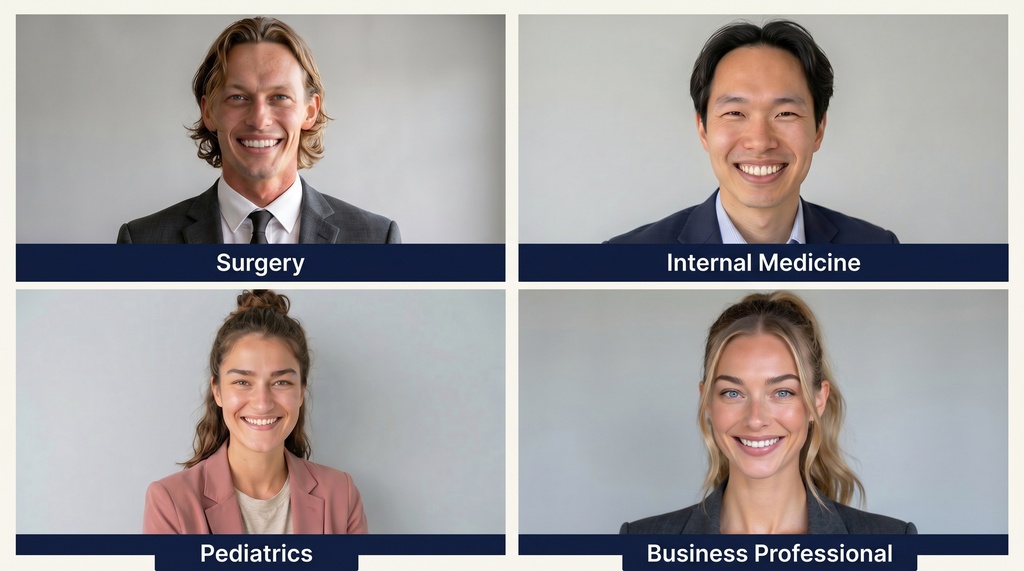
Internal medicine has no special AAMC rule. It inherits the standard "interview-day professional" look. Its conservative reputation comes from culture, not policy. If you are applying IM, the default outfit is exactly right: navy or charcoal jacket, light blue shirt, solid tie.
Henry David Photography's 26-27 guide offers the only specialty hints I found worth using:
| Specialty | Adjustment |
|---|---|
| Surgical specialties | Lean more formal: full suit and conservative tie |
| Internal medicine | Default. Conservative business professional |
| Pediatrics / family medicine | Slightly more warmth and personality allowed |
| Applying to multiple specialties | Pick the more formal option |
The logic mirrors how doctors dress by field in general, which I dig into in our doctor headshots guide. A surgeon and a pediatrician send different signals. Your photo can nod to that without shouting it.
One rule that surprised me: no scrubs, even for surgical applicants. Henry David is explicit about this. The photo is not the place to prove you belong in the OR.
And if you are applying across specialties with different cultures, dress up, not down. Optionality is power. The more formal photo works everywhere. The casual one does not.
Advice for Older and Non-Traditional Applicants
If you are an older or non-traditional applicant, the advice is simple: lean one notch more conservative.
No guide names "older applicants" directly. But the reasoning is clear. Wayne State and City Headshots both say the goal is to make faculty judge your application, not your photo. For anyone worried their photo might read as a mismatch, the safest move is the traditional uniform.
Here is the empirical anchor. A 2020 study in Surgery, Kassam et al., found photo professionalism was the appearance factor most strongly tied to receiving an interview. The effect even persisted after the committee was blinded to the photo.
But the same study found something important. Removing photos did not help diversity. It actually decreased interview invitations for URM and Asian applicants. A 2026 JMIR study of 2,681 applications found appearance links faded once you controlled for demographics, experience, and scores.
So I will not promise any outfit guarantees an interview. No honest guide can. What a clean photo does is remove distractions. It stops flash, shine, and loud color from competing with your application.
Good judgment comes from calibrated mistakes. The mistake here is easy to avoid: do not let your outfit become the story. For older applicants, that means dark solid colors, no patterns, no shortcuts.
The "Avoid" Checklist: What Actually Hurts Your Photo
A few mistakes recur across nearly every source. These are the ones that matter.
| Do not wear | Why |
|---|---|
| White coat in the primary photo | All 10 sources agree. Save it for after you match |
| Scrubs | Not standard, even for surgical applicants |
| Bright or loud colors | Med School Insiders flags red, orange, pink, and yellow |
| Busy patterns (plaid, stripes, checks) | They create visual noise and blur at small size |
| Shiny satin ties | Bounce light and pull the eye off your face |
| Sleeveless tops, visible bra straps | Create a distracting focal point |
| Low-cut necklines | Same problem: modest and structured wins |
| Statement jewelry | Reads as an oversized blob near your face |
| Phone selfies and filters | The r/IMGreddit thread is blunt about this |
One more that gets ignored: fit. Wayne State notes that "poor fit will negatively affect appearance and distract from your face." A jacket that pulls across the shoulders looks worse than a plain shirt that fits. Tailored beats fancy.
Complex problems usually have simple governing variables. For the ERAS photo, the governing variables are contrast, fit, and the absence of distraction. Nail those three and you are done.

How to Actually Get the Photo Taken
Once your outfit is chosen, you need the photo itself. You have three routes.
A studio session is the traditional path. Expect to pay a couple hundred dollars and spend part of a day. Quality is high, and a good studio handles the crop, background, and file specs for you.
Your school photo day is often free. If the timing works, take it. Just confirm they meet the 2.5 x 3.5 inch, 150 KB spec.
The third route is AI. Services like InstaHeadshots generate professional headshots from selfies for around $49 to $69, usually within an hour. You upload photos, pick a business-formal style, and get a range of options. For budget or time-pressed applicants, it is a practical way to get a compliant, clean image without booking a shoot.
Whatever route you pick, the outfit rules do not change. The framework for choosing colors that contrast with a light background is the same one I use in our headshot wardrobe guide.
Just remember the specs. IMGs upload through MyIntealth (ECFMG), which adds a verification step. A formatting error there can delay your transfer. Get the file right the first time. Our free ERAS Photo Checker catches those formatting errors before you submit.
The Bottom Line
Here is what I want you to take away.
There is no official AAMC dress code. The photo exists to identify you on interview day. The "suit rule" is consensus, not law.
So aim for interview-day professional. Navy or charcoal jacket, white or light blue shirt, solid tie for men, modest neckline for women, no white coat, plain light background.
Then stop optimizing for the perfect suit. Optimize for what reads clean at thumbnail scale: fit at the shoulders, collar shape, contrast, and the absence of shine and busy pattern.
In markets and careers, survival is underrated. Your photo does not need to win. It just needs to not lose. Remove the distractions, let your application speak, and move on to the parts of ERAS that actually decide your match.