
The ERAS Application Checklist That Sorts by Lead Time, Not Importance
A logistics-first ERAS Application Checklist for the 2027 Match. Sequence LORs, MSPE, ECFMG, transcripts, and your photo by lead time to avoid deadline disasters.


Most applicants think the ERAS application is won on the personal statement. It isn't.
I dug into the AAMC's own documents, program-director interviews, and cycle data to find where applications actually break. The pattern was clear. They rarely fail on the essay. They fail on logistics: a letter writer who misses the window, a transcript stuck in verification, an ECFMG delay, a photo that has to be redone the night before submission.
If you are a fourth-year student, an IMG, a DO, or a re-applicant, this is the anxiety I want to remove. You are not disorganized. You are just working from the wrong kind of checklist.
Here is a checklist built around lead time and dependency, not perceived importance. Because a "minor" item with a long turnaround is more dangerous than a "major" one you fully control.
The Fast Answer: Sort Every Item by Who Owns It
Complex problems usually have simple governing variables. For ERAS, the governing variable is not quality. It is ownership.
Some items you control directly. You can write your personal statement in a weekend if you must. Other items live on someone else's calendar: a letter writer, your Dean's office, ECFMG. Those are the ones that sink applications.
Here are the dates that anchor everything for the 2027 cycle:
| Date (2026-2027 cycle) | Event | What it means for you |
|---|---|---|
| June 4, 2026 | MyERAS opens | Request your token, upload your photo, start LORs |
| Sept. 2, 2026 | Applicants may submit to programs | The earliest you can send, not the target |
| Sept. 23, 2026 | Programs begin reviewing applications and MSPEs | The MSPE wave hits; your school must have uploaded |
| May 31, 2027 | Season ends | No new assignments after this |
Source: the 2027 ERAS timeline from AAMC.
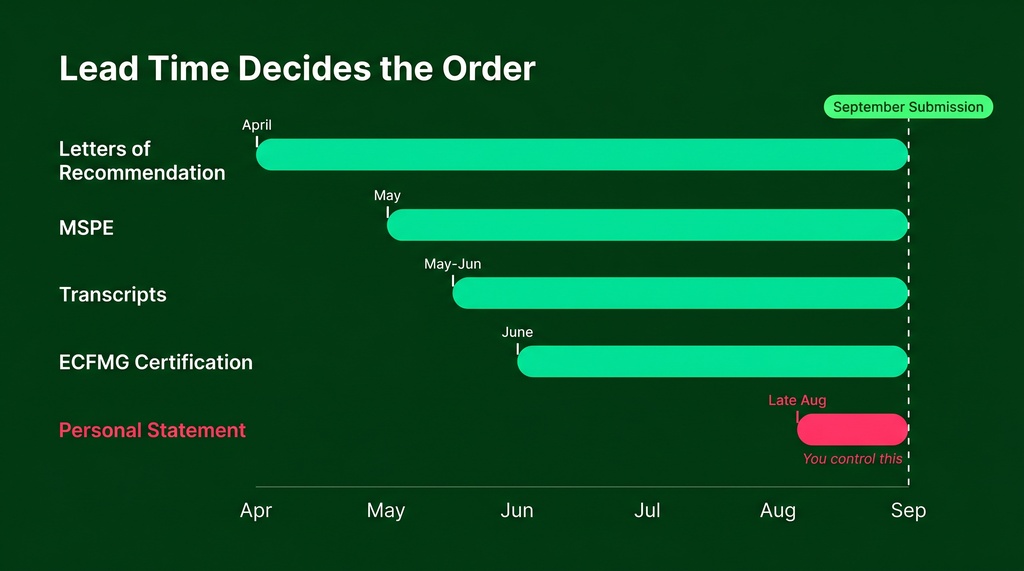
My one rule: every item must be finished or in-flight by mid-August 2026. The long-tail items (letters, MSPE, IMG certification) start in spring or earlier.
Speed matters, but direction matters more. Submitting fast with a broken file helps no one.
Why the "Big Three" Advice Fails You
The conventional wisdom says pour your energy into the personal statement, letters, and Step scores. Treat the rest as paperwork.
I disagree, and so does the data. AAMC's student resources state plainly that transcript problems are the number one cause of processing delays and missed deadlines. Not weak essays. Paperwork.
Think of it like risk management in markets. You do not manage your portfolio by staring at your best-performing position. You manage the tail risk, the thing that can wipe you out. In ERAS, the tail risk is the file you cannot touch.
I walk through the full backward-planning logic in my MyERAS timeline guide, but the short version is this: the dates that decide your Match happen months before September. They are the personal deadlines you set, not the official AAMC ones.
Don't confuse motion with progress. Rewriting your opening paragraph for the tenth time feels productive. It is not moving the items that can actually tank you.
The Four Items That Carry the Most Risk
These four depend on other people. Each has a known failure mode. Start them first.
Letters of Recommendation
Letters are the highest-stakes item you control through other people. The 2027 cycle is the first to use the new AAMC Letter Writer Portal, which means your writers face an unfamiliar system.
You can assign a maximum of four letters per specialty. Most programs ask for three. Amboss guidance confirms three is typical and two is the usual minimum.
So plan on contacting four to five writers in March or April. Not August.
Generic letters do nothing for you. One program director told the AMA he has seen so many templates that say nothing about the person. The fix is lead time. A writer you approach in April writes a real letter. A writer you rush in August sends a template.
Action: Finalize writers by April. Email each one your CV, draft personal statement, timeline, and the portal link the day MyERAS opens. Confirm upload two weeks before September 2.
MSPE (Dean's Letter)
The MSPE is school-controlled. You cannot upload it yourself. In 2027, programs may begin reviewing MSPEs on September 23.
Action: Submit your "noteworthy characteristics" draft to the Dean's office by July. If your school is a known late uploader, apply earlier to compensate.
Medical School Transcript
Your transcript is uploaded by the Dean's office. You will see "No Available Action" in MyERAS until it transmits. Trigger the process in May or June. Verify the upload on September 1.
ECFMG Certification (IMGs Only)
This is the long one. IMGs carry a dependency chain USMGs never see. If you need Pathways for Match eligibility, you must submit your application no later than January 31, 2027.
Certificate issuance takes 10 business days of standard processing. Real timelines run longer because scores travel from OET and credentials may need translation.
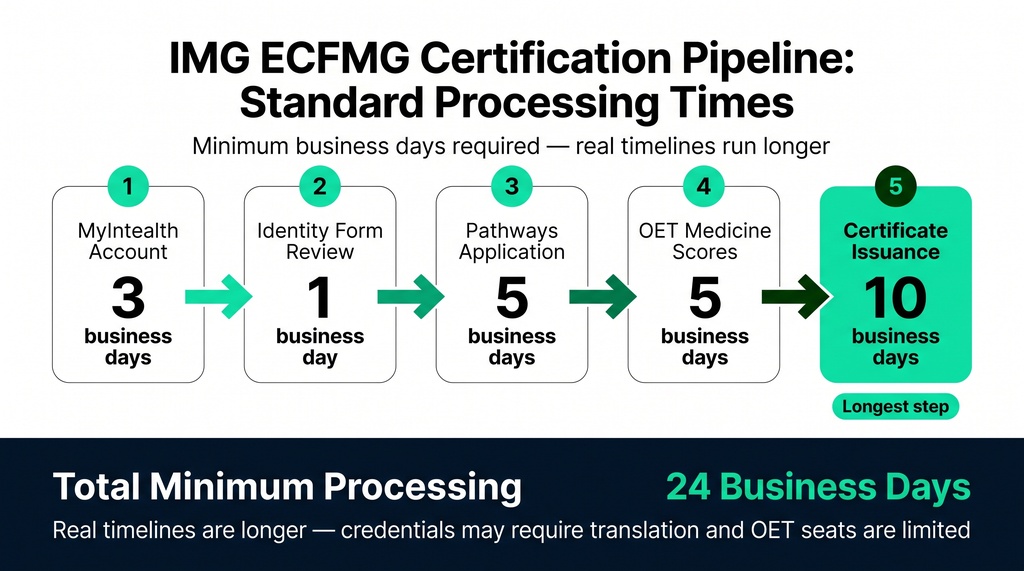
Action: Begin Pathways no later than October of the year before Match. OET Medicine registration can take months to find a seat in some countries. Do not wait for Step 2 CK to register. OET is independent.
The Photo: A Small Item That's Easy to Fumble
The photo is the textbook "small" item that people leave for the last night. That is exactly why it goes wrong.
Here is the good news: the photo is not a beauty contest. A 2026 JMIR retrospective of 2,681 applications found that any link between attractiveness and interviews disappeared after controlling for scores and experience. The photo's only job is to be compliant and recognizably you.
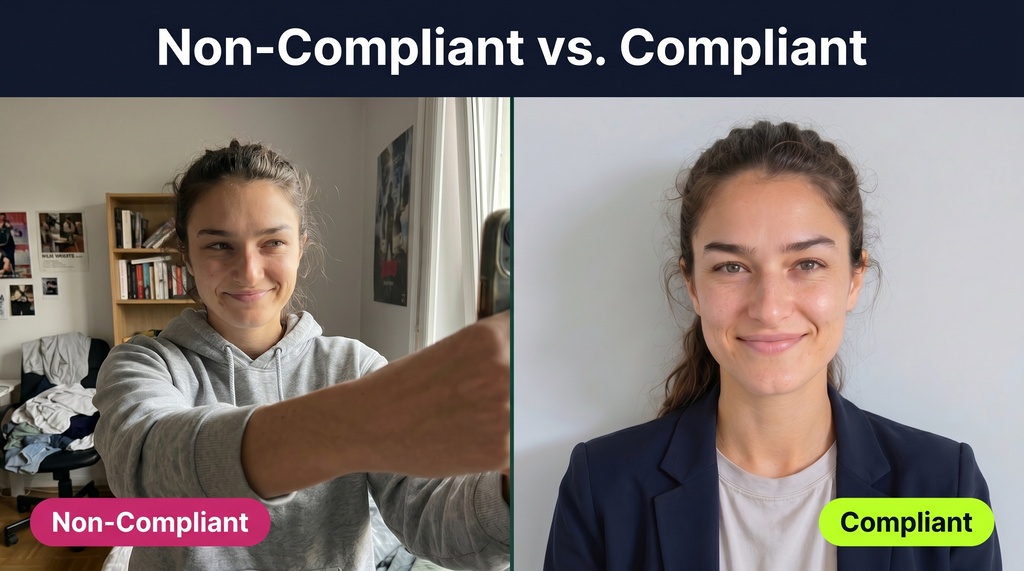
The real risk is failing validation. Most "photo problems" are boring technical mismatches: wrong dimensions, oversized files, bad filenames. Here is the spec to hit:
| Attribute | Requirement |
|---|---|
| File format | JPG/JPEG or PNG |
| File size | Under 150 KB |
| Print dimensions | 2.5 x 3.5 inches |
| Pixel dimensions | 375 x 525 px |
| Resolution | 150 dpi |
| Background | Plain white, light gray, or light blue |
| Attire | Business professional; no white coat needed |
The official AAMC photo chapter lists only three hard numbers. Default to the strictest safe read and you pass everywhere. I break down every technical detail in my ERAS photo guide.
One timing note. Studio slots crunch in late summer. August is competitive and September is emergency territory. Book in June or July.
On cost: a traditional studio session runs from $100 to $500 or more. AI headshot services now offer a faster route. A tool like InstaHeadshots starts around $49 and delivers dozens of options in minutes, with medical styling like blazers and clean backdrops. Whichever path you choose, validate the file against the AAMC spec before upload. Spec violations show up as upload errors, not warnings. To catch those errors ahead of time, run your photo through our free ERAS Photo Checker before you upload.
Program Selection: Budget by Specialty, Not by Average
A single "average" application count is useless at the personal level. Across the 2025-2026 cycle, the average applicant submitted 81.8 total applications. But the spread is enormous.
An IMG applying to Internal Medicine plans on close to 90 programs. A US MD in the same specialty plans on roughly 28. Same checklist items, very different program-selection budget.
The lesson: plan your workload against your specialty and applicant type, not a headline number.
Applicant-Type Branches Most Checklists Skip
A generic checklist fails because the bottleneck moves depending on who you are.
DOs: You transmit a COMLEX-USA transcript for an $80 one-time fee. If you apply to historically ACGME-only programs, also transmit a USMLE transcript. Psychiatry and Neurology are high-volume DO search specialties.
IMGs: ECFMG certification is a hard prerequisite. ECFMG uploads your photo, not you. Your Status Report loads only after certification. Everything starts months earlier.
Couples Match: ERAS itself barely changes. The pressure is in timing paired geography and interview logistics. Start early enough to settle your program pairs by mid-August.
Re-applicants: The 2027 cycle lets you import prior application data and letters from up to seven years back. Import the skeleton by mid-June. Replace stale letters by July. Add a "what changed" line to your personal statement as evidence of growth, not an apology.
Optionality is power. The more of these branches you handle early, the more room you keep to adapt.
Submit Mid-September, Not September 2
Here is the most underappreciated call in existing guidance. September 2 is the floor, not the target.
Early submission works because residency review is a rolling curve. A Residency Advisor study of roughly 400 mid-tier internal medicine applicants found Day 1 submitters got 1.6x more interviews than late-mid submitters, and Day 21-plus applicants dropped below baseline. A program director reading 4,000 applications reads the first 200 with more attention than the last 200.
So the goal is a complete file in mid-September, not a rushed file on September 2. Submit, then perfect. Not the other way around.
In markets and careers, survival is underrated. A complete, on-time application that clears every dependency beats a brilliant essay that arrives late.

The Checklist, Summarized
Patterns repeat. Most people just don't notice them. The applications that go sideways almost always break on lead time and overlooked details, not on the essay.
Here is the sequence I would run:
- April-May: Identify four to five letter writers. IMGs confirm the Pathway and register for OET.
- June 4: Get your token. Create letter entries and send portal links. Upload the photo. Request transcripts.
- June-August: Track letter uploads. Draft the personal statement (allow six weeks). Book the headshot early.
- August: Push the MSPE draft to the Dean's office. IMGs confirm the Status Report pipeline.
- September 1-2: Assign everything to every program. Verify uploads.
- Mid-September: Submit complete, and ride the rolling curve.
Good judgment comes from calibrated mistakes. You do not need to make the timing mistakes yourself when the pattern is already this clear. Start with the items you cannot control, handle the small ones early and correctly, and let the essay be the part you polish last.
That is how a strong application survives contact with everyone else's calendar.