
How to Get Your ERAS Photo: Photographer vs Phone vs AI
Your ERAS photo is a spec problem, not a prestige purchase. I compared photographer, phone, and AI to find the fastest, cheapest compliant route.

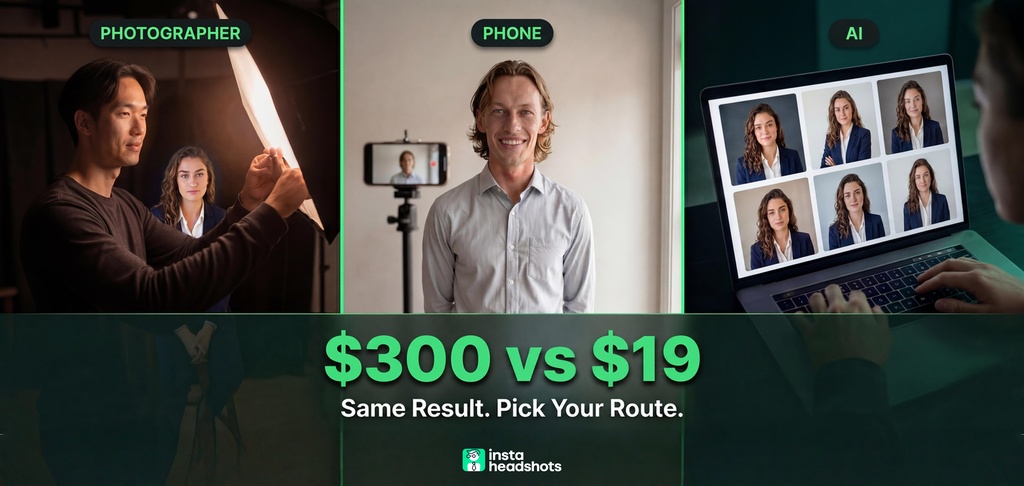
I got quoted $300 for an ERAS photo. Another applicant paid $19 for an AI version that passed on the first upload. Same requirement. Same outcome. A 16x price gap.
That gap sent me down a research hole. I read the AAMC rules, dozens of photographer guides, and every Reddit thread I could find. What I discovered surprised me. The ERAS photo is not a prestige purchase. It is a spec problem. Program directors do not evaluate who took your photo. They evaluate whether it is clean, professional, and meets the technical specs.
You are exhausted, broke, and buried in board prep. You do not need another expense or another errand. Here is exactly what your photo needs, and which of the three routes gets you there fastest and cheapest.
The Only Rules That Actually Matter
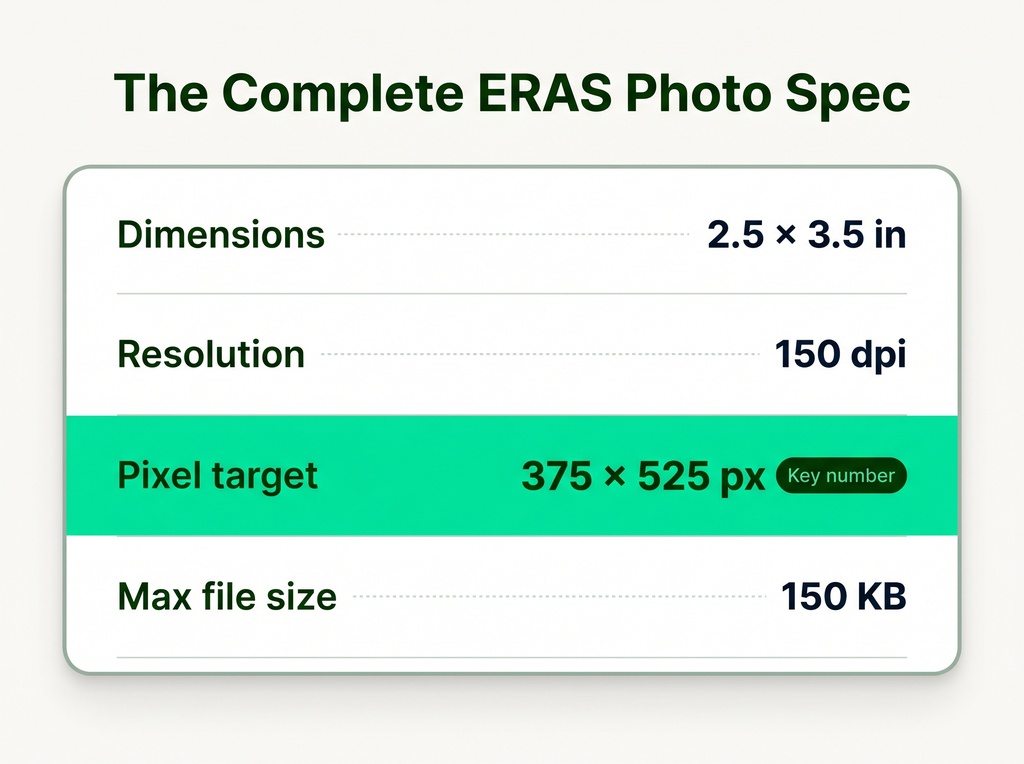
The official AAMC ERAS photo spec is three numbers. That is it.
- Dimensions: 2.5 in. x 3.5 in.
- Resolution: 150 dpi
- File size: 150 KB maximum
- Format: JPG/JPEG or PNG
Do the math and it lands on one pixel target: 375 x 525 pixels. Every compliant ERAS photo shares those dimensions. The AAMC photo chapter says the photo is "most often used by programs to help identify applicants when reporting for an interview." The mechanism is identification, not impression management.
Here is what the AAMC does not specify: background color, attire, expression, recency, or anything about AI versus human photography. That silence is why advisor blogs contradict each other. Some cap file size at 100 KB. Some demand JPEG only. The old 100 KB cap came from a retired upload pipeline and never got updated.
I cover every ERAS photo rule and the fastest compliant path in more depth, but the one-line recipe is simple: 375 x 525 pixels, JPEG, portrait, color, under 150 KB.
Complex problems usually have simple governing variables. This one has three.
Does a Program Director Care Who Took the Photo?
No. The evidence says the photo barely moves interview selection at all.
A 2026 JMIR study led by Mayo Clinic researchers analyzed 2,681 applications across 10 specialties. In the raw numbers, each extra point of "attractiveness" was tied to a 19% higher chance of an interview invite. But that link vanished after controlling for demographics and USMLE scores. Their conclusion: more attractive applicants do not have an edge from the ERAS photo once academics are controlled.
That is a shift from older work. A 2019 Duke review of 5,447 applications found attractive, non-obese applicants got interviews at a 24% rate versus 10% for the lowest group. The 2020 surgery paper, "Swipe right for surgical residency," found visual appearance was associated with interviews but did not ultimately affect selection.
Read together, the pattern is clear. The photo's signal shrinks as academic filters tighten. The strongest levers are your Step scores, clerkship grades, and program signals. The photo is not one of them.
Don't confuse motion with progress. Spending $300 to "stand out" chases a lever the newest data says barely exists.
The Three Routes, Side by Side
All three routes can technically pass. The real differentiators are time, cost, and reliability. Here is how they stack up.
| Dimension | Photographer | Phone / DIY | AI Headshot |
|---|---|---|---|
| Typical cost | $150-$700 (avg ~$283) | $0 | $49-$69 |
| Time to usable file | 1-3 hr shoot + 1-2 weeks edit | ~1 hr + trial and error | 15-90 min |
| Usable outputs | 2-5 keepers | 1 unless you retake | 40-200 |
| Background control | Studio backdrop | Whatever wall you find | Clean neutral generated |
| Lighting control | Professional | Inconsistent | Built-in simulation |
| Schedule dependency | Book 2-4 weeks ahead | Anytime | Anytime |
| Validation risk | Very low | Moderate | Low if resized to spec |
The average US headshot cost in 2025 was about $283, based on 700+ photographer listings. That same analysis found 74% of studios deliver three or fewer final images. You pay premium prices for minimal variety.
In markets and careers, survival is underrated. During your busiest season, the route that fails fewest applicants and costs least is the smart position.
When a Photographer Still Wins
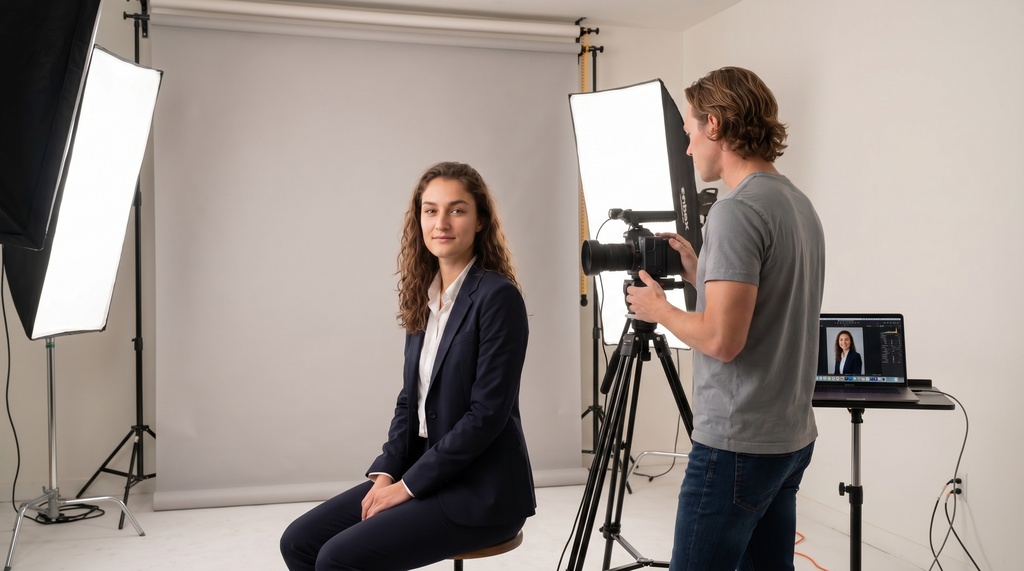
A photographer is the safest choice in specific cases. Book one 4-6 weeks before submission if any of these apply:
- You have visible scarring, a complex hairstyle, or heavy glasses that AI tends to misrepresent
- You want zero variance and can spend $200-$400
- You are in a niche or highly competitive specialty and prefer real-photon capture
One New York photographer put it bluntly: "Lighting is the deciding factor" in nearly every bad DIY photo. That is true. A good photographer controls light better than you can with a lamp.
But price does not guarantee quality. One Reddit applicant paid $200 for a shoot that "came out looking atrocious" with poor retouching and an awkward crop. Photography quality is bimodal, not price-correlated. If you go this route, ask to see prior ERAS-specific samples first.
When a Phone Still Wins
A phone photo costs $0 and can absolutely pass. The r/medicalschool community has a well-tested protocol.
Here is the DIY approach that works:
- Stand 6+ feet from a plain wall, with the camera 10-20 feet back for natural compression
- Use window light from the camera side, with white poster board on the shadow side
- Use timer mode and a tripod. Never shoot at arm's length
- Capture 30-50 frames. Pick the sharpest with eyes visible and centered
- Edit only exposure, white balance, and crop. No skin smoothing
- Resize to exactly 375 x 525 px, JPEG, under 150 KB
The technique matters more than gear. A recent phone plus good light beats a bad studio shoot. The catch is skill and patience. Lighting and framing take trial and error, and you are short on both time and patience right now.
The most common phone failure is a wrong aspect ratio. Platforms crop by shape, not file size, so a landscape frame gets sliced wrong. Validate before you upload.
When AI Wins
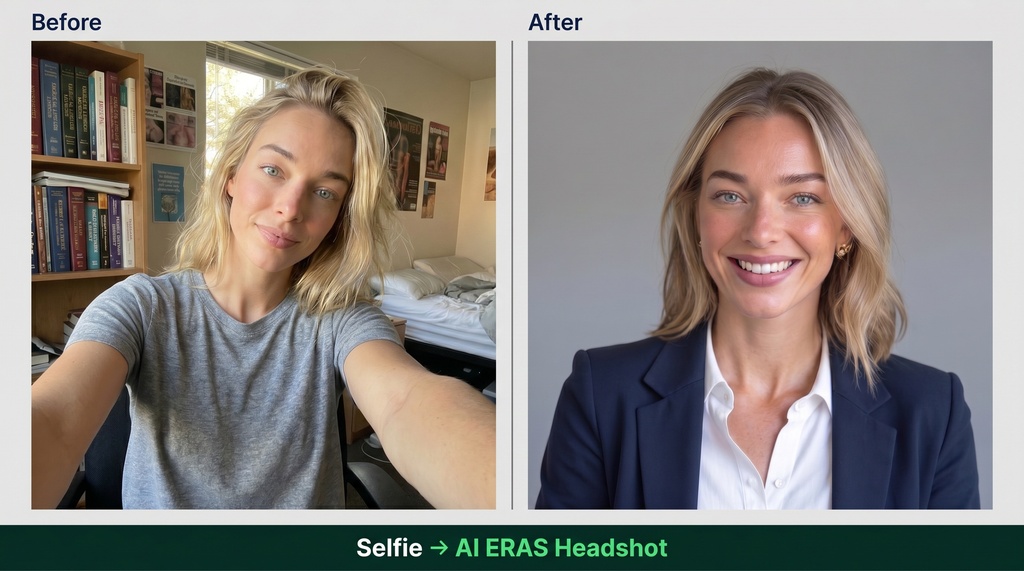
For a time-poor, budget-tight applicant, AI is the fastest route to a compliant photo. You go from selfies to an uploaded file in one evening.
AI headshots return a full set in 15 to 90 minutes versus 1-2 weeks of photographer turnaround. You get 40 to 200 outputs instead of 2-3. And the price sits at $49-$69 instead of an average $283 studio session. That is a 5-10x cost gap before travel and retake fees.
The workflow is simple:
- Gather 5-15 selfies with varied angles and lighting, plain backgrounds, your current hair and glasses
- Upload and pick a tier based on how much variety you want
- Wait 15-90 minutes
- Choose the output that most looks like you. Confirm glasses, facial hair, and skin tone match
- Resize to 375 x 525 px, JPEG, under 150 KB
- Validate against the spec and ask a friend if it looks like you
Tools like Instaheadshots train a model on your photos and generate hundreds of professional looks with medical-appropriate styling. They also offer a free ERAS photo checker that validates your file instantly. AI headshots are already common in healthcare for directories, telehealth, and journals, as I cover in my guide to AI headshots for doctors.
Is AI Against ERAS Rules?
No, the AAMC has not published a ban on AI-generated ERAS photos. But there is a real caveat you must respect.
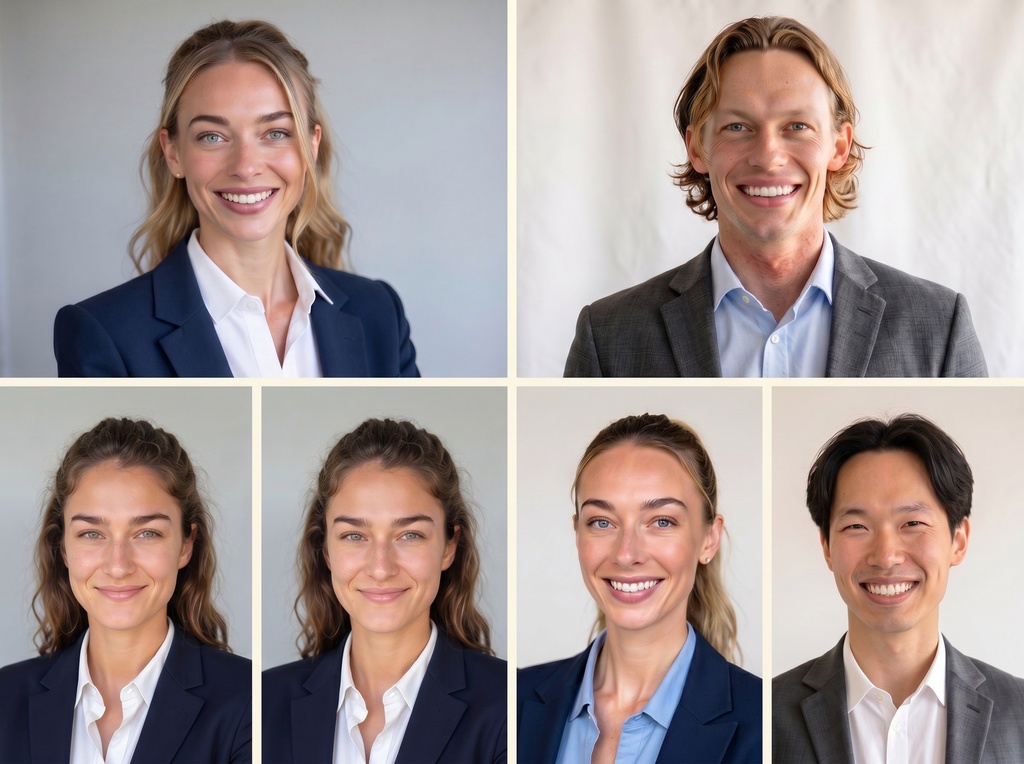
Some photographer-side advisors note that certain programs have begun flagging clearly AI-generated images. Keep in mind those warnings come from businesses that sell photography, so treat them as advisor perspective, not policy. Their concern is fair, though: a bad AI generator can alter face shape, skin texture, or eye color, and that breaks the one rule that matters. The photo must recognizably look like you.
So the standard is simple. Pick a generator with high likeness scores and verify the output still looks like you. One benchmark reported a top average likeness score of 0.680, though that figure is company-stated, not independently audited. The Reddit complaint that "AI looked kind of fake" usually points to a lower-tier tool, not the whole category.
Good judgment comes from calibrated mistakes. The mistake to avoid here is uploading an image that does not look like the person walking into the interview.
What to Wear and Skip the White Coat
There is no official AAMC dress code. The "suit rule" came from photographers and career offices, not the AAMC. But the community consensus is nearly unanimous.
The consensus outfit across 10 career-office and studio guides:
- Navy or charcoal blazer
- White or light blue collared shirt
- Solid subtle tie, modest neckline
- Small jewelry, no busy patterns
- Plain white, light gray, or light blue background
And skip the white coat. All 10 guides agree. One St. Louis photographer notes a short coat can read as presumptuous before you are an attending. The suit jacket alone is the safer call. This works for all three routes, including AI, where you upload your own shirt and blazer choices.
One Note for IMGs
If you are an international medical graduate, you do not upload directly to MyERAS. You upload through the ECFMG MyIntealth portal, and ECFMG verifies and forwards your image.
The practical implication is timing. One applicant reported the portal said 24 hours to process the upload. Treat MyIntealth as a 24-hour buffer step, not a same-night submit. All three photo routes work equally for IMGs. The extra routing time just favors the fastest-ready source, which is AI or DIY.
My Bottom Line
The ERAS photo is a spec-driven task, not a prestige purchase. Back into the actual requirements and all three routes can pass. The differences are time, cost, and reliability.
Here is how I would choose:
- Time-rich, budget-loose, or a tricky face for AI: Book a photographer 4-6 weeks out. Low variance, one afternoon, $200-$400.
- Time-rich, budget-tight, good light at home: DIY with a phone, window light, and a plain wall. $0, one weekend. Validate before upload.
- Time-poor, budget-tight, generalized applicant: AI. $49-$69, 15-90 minutes, the most options to choose from.
Whatever you pick, the mechanic that fails the most applicants is the same: missing the 150 KB cap or the 375 x 525 pixel target. Validate every output against the spec before you submit.
Speed matters, but direction matters more. Get the photo done fast, get it compliant, then spend your real energy on the levers that actually move your match: your scores, your letters, and your signals.