
ERAS 2027 Key Dates & Deadlines: The Only AAMC-Confirmed Timeline You Need
The ERAS 2027 key dates and deadlines, split by what AAMC actually confirms vs what people wrongly treat as universal. Plus a buffer-based planning checklist.


I went down the ERAS date rabbit hole so you don't have to. I opened five tabs. Reddit, a school PDF, two old blogs, and the AAMC page. Four of them disagreed.
Here's what I found. Most "ERAS date lists" mix years, fold in NRMP dates that AAMC doesn't own, and repeat an "October 1 MSPE" rule that isn't on the 2027 timeline at all. That's not a knowledge problem. This is a systems issue. People don't miss deadlines because they didn't know a date. They miss them because they built plans on dates that were never real deadlines.
If you're juggling rotations, sub-Is, and letter chasing, you need one clean, labeled timeline. Not five.
So I built it. Below are the AAMC-confirmed ERAS 2027 dates, clearly separated from the stuff that varies by school and program. Then I'll show you how to build buffers so a late letter or a slow dean's office doesn't wreck your cycle.
The 5 AAMC-Confirmed ERAS 2027 Residency Dates
Here's the short answer. AAMC publishes exactly five national residency dates for the 2027 cycle. That's it. Everything else you've seen floating around is either NRMP, your school, or folklore.
All times are Eastern. These come straight from the official 2027 ERAS Residency Timeline.
| Date | Time (ET) | What Happens |
|---|---|---|
| May 31, 2026 | 5 p.m. | 2026 ERAS season ends |
| June 4, 2026 | 9 a.m. | 2027 season begins. MyERAS portal opens |
| September 2, 2026 | 9 a.m. | Applicants may begin submitting to programs |
| September 23, 2026 | 9 a.m. | Programs may begin reviewing apps + MSPEs in PDWS |
| May 31, 2027 | 5 p.m. | 2027 ERAS season ends |
That's your entire national timeline. Print it. Put it on a wall.
What this means for you, in plain English:
- June 4 to September 2: You build and certify your application. You cannot submit yet. Use every day.
- September 2 to September 23: Your app is "submitted but invisible." Programs can't see it until the 23rd. Submitting on the 2nd vs the 22nd doesn't change when you're first read. It only changes whether you have time to fix a rejected upload.
- May 31, 2027: The last day you can add programs or change assignments.
One more thing worth saying loudly. There's a firm sixth date most guides skip: the supplemental ERAS application must be assigned and submitted by September 23, 2026. Same day program review opens. I'll come back to that trap.
What People Wrongly Treat as ERAS Deadlines
This is where cycles quietly go sideways. A date list without labels is what causes missed deadlines. Constraints create clarity, so let me draw the hard line.
NRMP is a different organization with a different calendar
NRMP runs the Match. ERAS delivers your application. Two systems. Two logins. You can be fully submitted in ERAS and not be in the Match at all.
Here are the 2027 NRMP Main Residency Match dates:
| Date | Time (ET) | NRMP Activity |
|---|---|---|
| September 15, 2026 | 12 p.m. EDT | Match registration opens |
| January 29, 2027 | 11:59 p.m. EST | Standard registration deadline ($50 late fee after) |
| February 1, 2027 | 12 p.m. EST | Ranking opens |
| March 3, 2027 | 9 p.m. EST | Rank Order List certification deadline |
| March 20, 2027 | 12 p.m. EDT | Match Day |
Read this twice. "I missed September 2 ERAS submission" is recoverable. "I missed March 3 NRMP certification" means you don't Match. One student I read about submitted ERAS by September 4, got 12 interviews, and never registered with NRMP because they assumed it was automatic. On Match Week, they had no rank list and couldn't participate. Don't be that story.
The "October 1 MSPE" date is folklore
This one is everywhere. Even the AAFP still says MSPEs release "typically October 1." But AAMC does not publish a hard MSPE release date for 2027.
Here's how both things can be true. Your Designated Dean's Office uploads the MSPE. For residency applicants, it's auto-sent to every program you apply to. It only becomes visible to programs on September 23, 2026. Not October 1.
So plan backwards from September 23, not from a rumor. Chase your dean's office for their internal upload target. One student I came across thought their MSPE was "due October 1." Their dean's actual internal target was September 11. October 1 is folklore. September 23 is real.
LoR upload has no fixed AAMC deadline
Many guides claim letters are "due September 22." AAMC publishes no such date. The Letter Writer Portal opens June 4, 2026 and runs through May 31, 2027.
The real deadline is whenever a program stops accepting letters for an interviewed applicant. That varies. Treat it as variable.
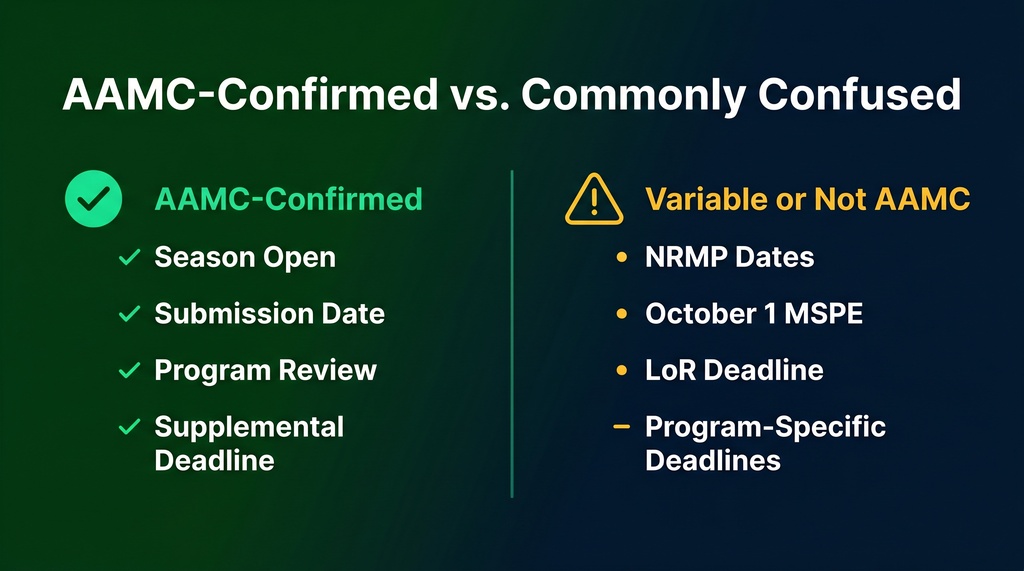
The Confusion Table: Confirmed vs Variable
Here's the whole thing in one view. This is the label layer most date lists skip.
| Item | AAMC-Confirmed? | Owner | How to Label It |
|---|---|---|---|
| Season begins (June 4, 2026) | Yes | AAMC | AAMC-confirmed |
| Submission opens (Sept 2, 2026) | Yes | AAMC | AAMC-confirmed |
| Program review opens (Sept 23, 2026) | Yes | AAMC | AAMC-confirmed |
| Supplemental app deadline (Sept 23, 2026) | Yes | AAMC | AAMC-confirmed |
| Season closes (May 31, 2027) | Yes | AAMC | AAMC-confirmed |
| NRMP registration/certification | No | NRMP | NRMP, not AAMC |
| Match Day | No | NRMP | NRMP, not AAMC |
| "October 1" MSPE release | No | Dean's Office | Variable, ask your dean |
| LoR upload deadline | No | Writer + program | Variable |
| Program-specific materials | No | Each program | Variable, check each |
My rule: ignore any guide that lists "October 1 MSPE" as an AAMC date or merges NRMP into the ERAS timeline. It's a tell that the guide is sloppy.
Two 2027 Changes That Trip People Up
Dates are stable year to year. The toolset around them moves. Two changes matter this cycle.
The supplemental app has two steps, not one
The 2027 supplemental application includes program signals, geographic preferences (new for 2027), past experiences, and a short story. AAMC is explicit: "The process includes both an assignment step AND a submission/certification step. Both must be completed."
I read about an applicant who submitted MyERAS on September 5, thought the supplemental was one click, and never certified it. The signals didn't count. The geographic preferences never reached programs. Two steps. Finish both by September 23.
Signal counts also change every cycle. For 2027, 28+ specialties participate, with gold/silver tiers in specialties like Anesthesiology, Dermatology, and Internal Medicine. Always re-verify your specialty's count for the cycle you're applying to.
Old LoR requests expire on June 4
The new Letter Writer Portal replaces the old MyERAS LoRP. Every unfulfilled request from the 2026 season is void when the 2027 season opens. AAMC says requests sent before June 4 "must be requested again."
So that letter writer who said "I'll get to it after Match Week"? That promise dies on June 4. Re-request early. Every LoR promise lives or dies on that date.
The IMG Sub-Calendar: Work Backwards From June 24
If you're an IMG, the season opens June 4, but you can't use your token yet. ECFMG/Applied Intealth distributes IMG tokens "beginning June 24, 2026." That's three weeks after the season opens.
So June 24 is your real unblocking date, not June 4. And ECFMG calls it "expected," so build a one-week buffer.
Get your credentialing done well before then: Step 2 CK result, ECFMG certification status, photo, and MSPE decision. One Caribbean-school applicant planned to register June 5, then discovered their dean's office needed a separate signed MSPE release form. The June 24 token was the gate. Without a buffer, they'd have started three weeks late.
Build Buffers Around the Dates That Aren't Really Deadlines
A clean date list is helpful. A clean date list with buffers is protective. Leverage beats effort here. The five AAMC dates are the rails. Everything variable needs padding.
Think of it like progressive overload in the gym. You don't max out on day one. You build in room to recover and adjust. Same logic here.
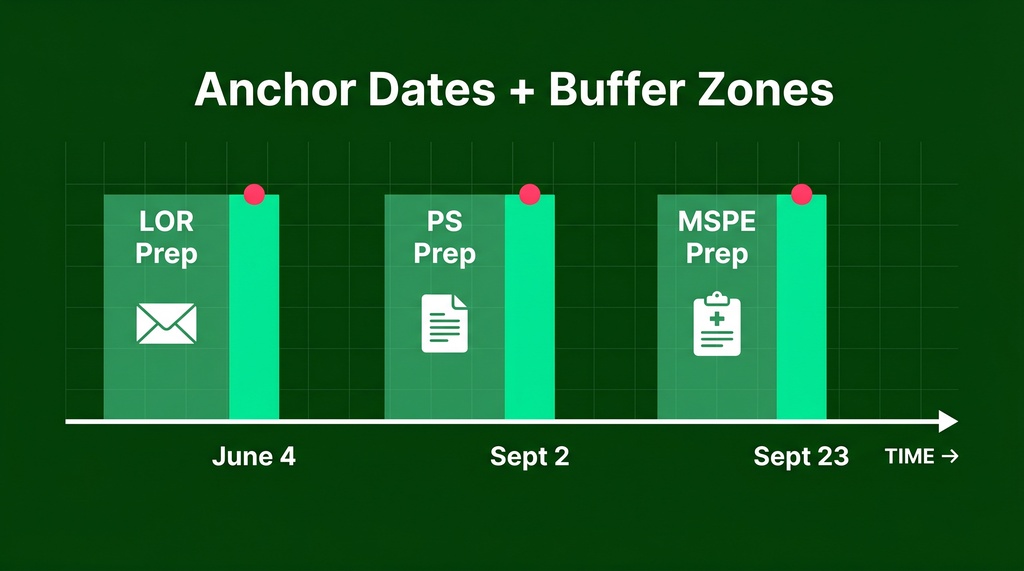
Here's the buffer plan I'd run:
| Variable Item | Buffer Pattern |
|---|---|
| Letters of recommendation | Ask by June 30. Re-request via the new portal in early June. Check for receipt every Friday, July to September. |
| MSPE upload | Ask your dean's office by July 1 for a target 2-3 weeks before September 23. |
| Step 2 CK / COMLEX Level 2 | Sit early enough that scores post 3+ weeks before September 2. |
| Personal statement | Lock the final version by August 15. |
| Supplemental app | Assign AND certify by September 22, a day before the cutoff. |
| NRMP registration | Register before November to skip the late fee. |
| Rank Order List | First certify in early February. Final by March 2, keeping March 3 as a hard backstop. |
And yes, submit early. A Residency Advisor study of mid-tier internal medicine applicants found Day 1 submitters got 1.6x more interviews than late-mid submitters, as I cover in my MyERAS timeline guide. Don't scale your program list before you've stabilized your core materials.
Don't Forget the Boring Prep Items
While you're tracking dates, knock out the small stuff early. The ERAS photo is one of them. It's a required upload that people leave to the last day and then panic over.
The official AAMC photo spec is only three numbers: 2.5 x 3.5 inches, 150 dpi, and 150 KB max. Most "photo problems" are technical mismatches, not quality issues. A safe read is 375 x 525 pixels, JPEG, under 150 KB.
If you're short on time, an AI headshot service like InstaHeadshots can produce a compliant, professional photo in about 15 minutes from selfies, versus roughly $300 and half a day at a studio. Executives at large firms may still prefer traditional photography, but for a fast, compliant ERAS photo it's a reasonable option. Either way, get it done in June, not September. And before you upload, run it through our free ERAS Photo Checker to confirm it's compliant.
Your Calendar Setup in 5 Steps
Here's how I'd wire this into one system:
- Use one calendar with three colors: blue for AAMC, green for NRMP, orange for variable items (LoRs, MSPE, essays).
- Set reminders at 7, 3, and 1 day before every AAMC and NRMP date.
- Re-verify each AAMC date at its official URL 30 days out. AAMC occasionally adjusts preview dates.
- Print the AAMC 2027 Residency Timeline and the NRMP calendar side by side. They're not the same calendar.
- Trust the AAMC site over Reddit, school PDFs, and old blogs for the national dates.
The Bottom Line
For ERAS, accuracy beats speed. Use only the five AAMC-confirmed dates for your national timeline. Treat MSPE timing, LoR turnaround, and program deadlines as variable, and pad them.
Most application failures aren't knowledge gaps. They're structural. Someone built a plan on a date that was never a real deadline. The buck stops with you here, so give yourself the buffers.
Print the five-date table. Register with NRMP by November. Re-request your letters on June 4. Then go back to your rotations knowing your timeline is solid.