
The MyERAS Timeline Guide: Backward-Planning Your Whole Match
A data-driven MyERAS timeline guide for 2026-2027. Learn the real soft deadlines behind every AAMC date, plus why the ERAS photo is an easy early win.


I went down a rabbit hole on the ERAS timeline, and the data surprised me. Most applicants treat it as one big September deadline. Submit by then, and you're fine, right?
Wrong. When I broke the cycle down, I found something interesting. The dates that actually decide your Match happen months before September. They're not on any official AAMC calendar. They're the personal prep deadlines you set for yourself.
I know you're juggling Step 2 CK, away rotations, letters, and essays all at once. The fear of missing something that tanks your whole cycle is real. This guide fixes that.
Here's what I learned building a backward-planned calendar from the official dates, including why the ERAS photo is the easiest early win most people fumble.
The 5 Official Dates You Actually Need
Let me give you the answer first. The 2026-2027 MyERAS cycle has five hard AAMC dates. Everything else is prep you control.
| Date | What Happens |
|---|---|
| June 4, 2026 (9 a.m. ET) | MyERAS season opens; start your application |
| June 25, 2026 | Token registration open (IMGs via ECFMG) |
| Sept. 2, 2026 (9 a.m. ET) | Applicants may begin submitting |
| Sept. 23, 2026 (9 a.m. ET) | Programs begin reviewing in PDWS |
| May 31, 2027 | 2027 ERAS season ends |
These come straight from the AAMC 2027 timeline. They're fixed. They repeat every year.
Then there's a whole second system: NRMP. This is where people get confused. ERAS delivers your application. NRMP runs the match algorithm.
| NRMP Date | Event |
|---|---|
| Sept. 15, 2026 | NRMP registration opens ($70 fee) |
| Jan. 29, 2027 | Standard registration deadline |
| Feb. 1, 2027 | Rank Order List opens |
| Mar. 3, 2027 (9 p.m. EST) | ROL certification deadline |
| Mar. 15-18, 2027 | SOAP |
| Mar. 19, 2027 (12 p.m. EDT) | Match Day |
Conflating ERAS and NRMP is the second most common applicant mistake. Miss the March 3 ROL certification and you don't Match. Full stop. Set that calendar reminder now.
Why the September Deadline Myth Is Costing You Interviews
Here's the part that surprised me. The conventional wisdom ("just submit by September") is not just incomplete. It's actively hurting applicants who follow it.
I was skeptical too, until I looked at the numbers. Residency Advisor's January 2026 study of about 400 mid-tier internal medicine applicants measured interview invites by submission slot.
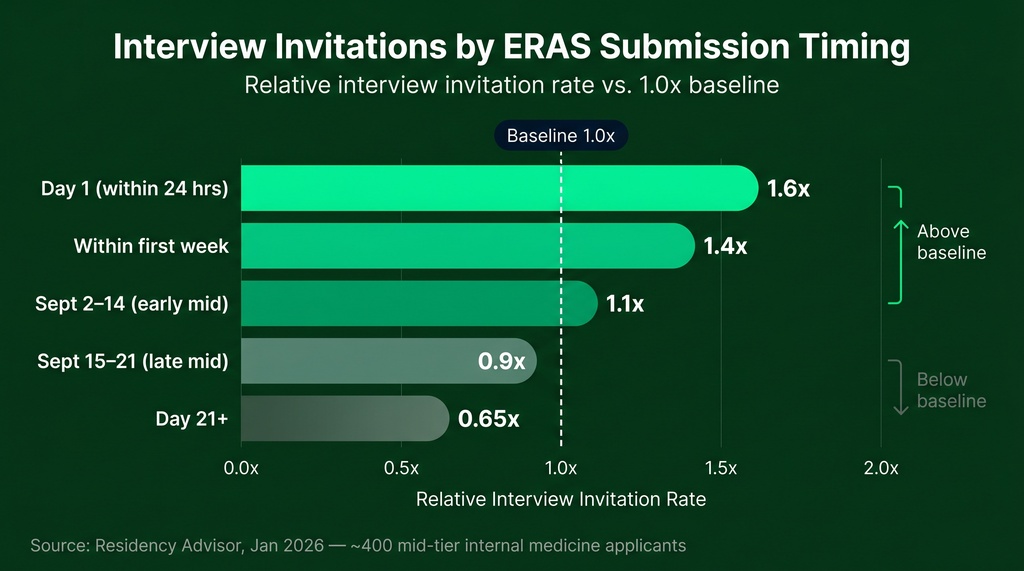
Day 1 submitters got 1.6x more interviews than late-mid submitters. Day 21-plus folks dropped to 0.65x baseline.
In ultra-competitive specialties like dermatology and orthopedics, the gap widens to a 25-35% lift for early submitters.
Let me nerd out on the mechanism for a second. A program director with 4,000 IM applications reads the first 200 with more attention than the last 200. Early submission slots you at the front of the queue. It also frees interview slots before their calendar fills.
Think of it like marathon pacing. You don't sprint the last mile and expect to make up for a slow start. The lead you build early is the lead you keep.
So the real goal isn't "submit by September." It's "submit on Day 1, September 2." And you can only do that if your prep is already done.
The Three Layers of the ERAS Timeline
When I mapped this out, I saw three distinct layers. Two are public and fixed. One is private and where the real work happens.
| Layer | What It Is | Who Controls It |
|---|---|---|
| Official AAMC dates | 5 hard dates | External (fixed) |
| NRMP/Match dates | 6 dates | External (fixed) |
| Your soft deadlines | 8-10 prep tasks | You |
The third layer is the one nobody talks about. It's where applicants who Match well separate from those who scramble.
Here's the trap: applicants treat layer three as invention instead of discovery. They wait for September, then race to invent a timeline. The winners discovered their prep deadlines back in April.
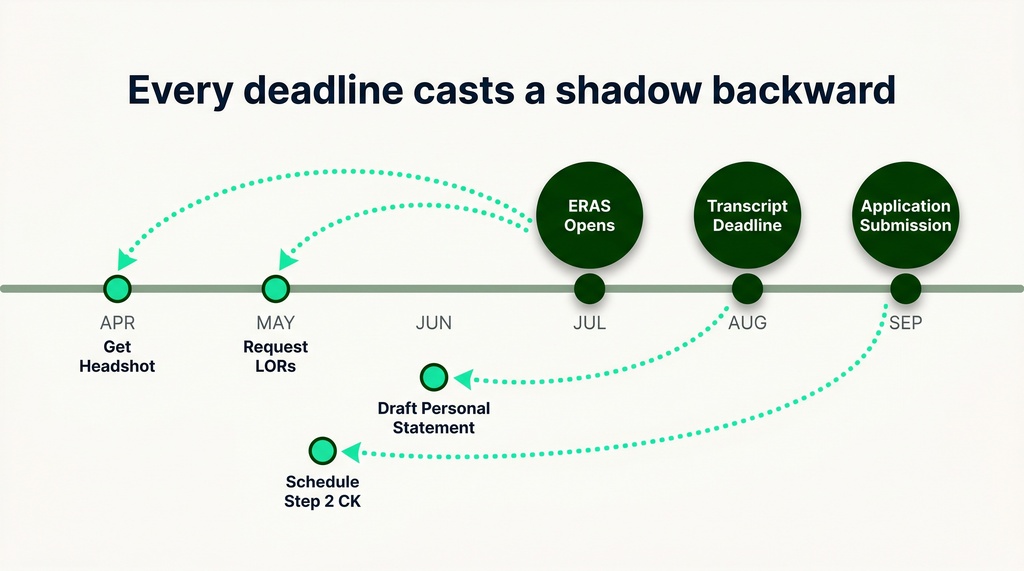
Every official date has a backward-extending soft deadline. Let me show you the cascade.
The ERAS Photo: Your Easiest Early Win
Okay, but here's where it gets interesting. The single most avoidable late-summer stressor is the photo.
Most applicants believe the photo is a trivial, last-minute task. Knock it out the week before submitting. This belief is wrong, and it creates a bottleneck.
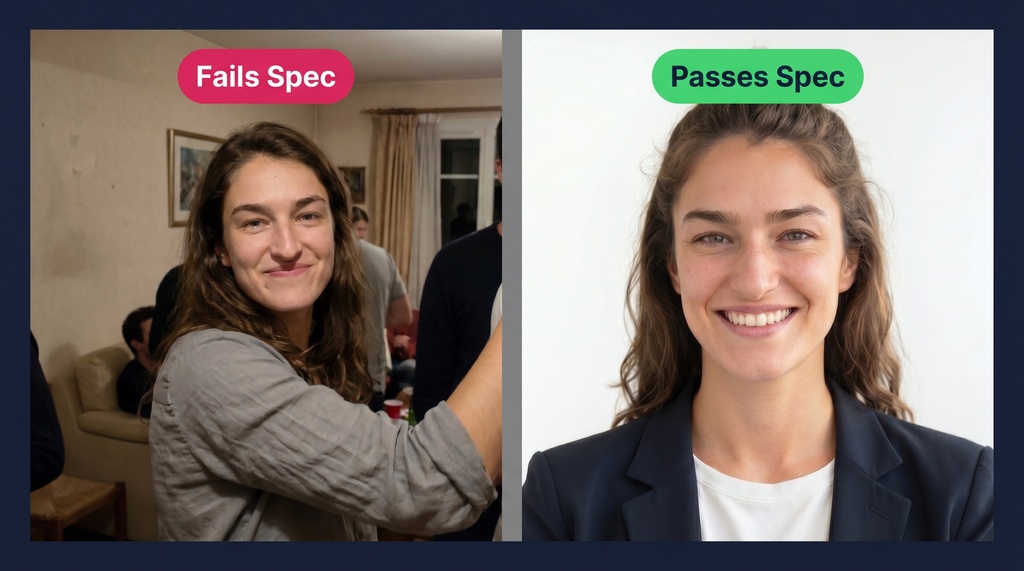
The ERAS photo is a spec-heavy deliverable that blocks fast. Get one number wrong and validation fails on upload day. Here are the requirements.
| Spec | Requirement |
|---|---|
| Print size | 2.5 x 3.5 inches (passport standard) |
| Resolution | 150 dpi minimum |
| Pixel dimensions | 375 x 525 (minimum) |
| File size | 150 KB max |
| Formats | JPEG or PNG only |
| Color | Color only |
| Background | Plain off-white, light gray, or pale blue |
| Framing | Head and shoulders, face centered, eyes open |
| Recency | Taken within last 6 months |
| Attire | Professional business attire (white coat optional) |
The official AAMC photo spec lists only three hard numbers: the size, the dpi, and the file cap. But guides disagree on details. My advice: default to the strictest reading (JPEG, under 150 KB, 375 x 525) and you're safe on every version.
Here's the part that trips people up. Aspect ratio is where photos quietly fail. Platforms crop by shape, not file size. A wrong ratio stretches or cuts your face. I dug into this in the headshot dimensions guide, and it's the most common silent error.
Does a Better-Looking Photo Win Interviews?
No. And I love this finding because it contradicts the panic. A 2026 retrospective study in JMIR Medical Education analyzed 2,681 applications across 10 specialties, which I cover in the ERAS photo guide.
Each extra point of "attractiveness" was tied to a 19% higher interview likelihood. But that link vanished after controlling for USMLE scores and experience. The photo's real job is to be compliant, unambiguous, and recognizably you. That's it.
AI vs. Traditional: The Cost and Speed Math
Here's why the photo should be a May or June task, not an August one. Traditional photographers book out fast. One studio's 2026 ERAS guide notes August is fully booked in most major metros.
| Option | Cost (USD) | Turnaround |
|---|---|---|
| AI headshot services | $29-$119 | 1-3 hours |
| Local photographer | $150-$325 (avg ~$232) | 3-7 days |
| Premium residency photographer | $400-$700 | 5-14 days |
AI headshot services are the low-friction route. Tools like InstaHeadshots generate dozens of options in about 15 minutes for $49 to $69, with medical styling like white coats and clean backdrops. You upload 10 selfies, and you get a compliant image without booking anything. Then run the result through our free ERAS Photo Checker to confirm it passes before upload day.
One caveat from my research: free AI tools usually output low-resolution, watermarked images, as I found when I ran the numbers. For a career-facing photo with a hard resolution spec, that's a false economy.
For most applicants, a paid AI headshot or a $200 local shoot in June both work. Applicants in top-tier competitive specialties may prefer a traditional shoot with wardrobe styling. Either way, finish it by August 1. Give yourself a re-do buffer.
Letters of Recommendation: The Real Bottleneck
If the photo is the easy win, letters are the hard gate. This is the single greatest source of late-summer stress, and it's a math problem.
Writing a strong letter takes time. Per Shemmassian's advisor guidance, here are realistic lead times.
| Letter Type | Lead Time |
|---|---|
| Core clinical letter (busy attending) | 6-10 weeks |
| Sub-I / away rotation letter | 8-10 weeks |
| Research mentor letter | 4-6 weeks |
| Chair letter | 8-12 weeks |
Do the math backward from September 2. A chair letter at 12 weeks means your ask lands in early June at the latest. Realistically, you want formal requests out by April or May.
A reminder email is not a substitute for time. Writers need 3 to 5 drafts before they're satisfied. You cannot compress that.
Good news for 2027: the new AAMC Letter Writer Portal replaces the old per-program upload workflow. Your writer uploads one document that goes to every program you assign. It's one of the rare AAMC upgrades that reduces your work instead of adding to it.
Personal Statement, Step 2 CK, and the MSPE Blind Window
Three more prep tasks feed the September 2 deadline. Each has its own soft deadline.
Personal statement. The AAMC caps it at 28,000 characters, but that's a ceiling, not a target. The working range is 4,000 to 5,300 characters (about 700 to 900 words). Advisors recommend 5 to 7 revision passes. That means a March outline and an April first draft, so you have time to revise.
Step 2 CK. Since Step 1 went pass/fail in 2022, weight shifted to Step 2 CK. Take it by July at the latest. Applicants who wait until August risk a score release that arrives after programs start reviewing on September 23.
The MSPE (Dean's Letter). This one has a hidden trap. Per the AAMC MSPE FAQ, the information cutoff is October 1 of your MS-3 year. It releases to programs September 23.
Here's the blind window: anything that happens after October 1 of MS-3 cannot be added. A stellar MS-4 rotation in September will not appear in your MSPE. Many applicants assume it will. It won't.
This pushes weight onto your MS-3 clerkships, your letters, and your away rotation evaluations.
Your Month-by-Month Backward Plan
Let me pull it all together. Here's the cascade, working backward from the dates you can't control to the tasks you can.
Here's the same plan as a quick-reference table.
| When | What | Why |
|---|---|---|
| Dec 2025 | Specialty talk, MSPE review | MSPE writers cue on direction |
| Jan-Apr 2026 | Step 2 CK, PS draft, LOR asks | Letters take 6-10 weeks |
| May-Jun 2026 | Photo done, MyERAS opens June 4 | 10-week buffer to Sept 2 |
| Jul 2026 | Program list, tailor PS | Last window for big PS edits |
| Aug 1, 2026 | Photo finished | Buffer for a re-do |
| Aug 30, 2026 | All docs in portal | 3-day buffer before Sept 2 |
| Sept 2, 2026 | SUBMIT | Day 1 = 1.6x more interviews |
| Mar 3, 2027 | Certify ROL | Miss it, no Match |

A Quick Note for IMGs
If you're an international medical graduate, your timeline compresses by about 6 weeks. You have two extra gates.
First, you need a token. You register with ECFMG starting May 13, 2026, and receive your token around June 24 via MyIntealth. USMGs skip this and use AAMC credentials directly.
Second, you can't submit until ECFMG verifies your credentials. That process takes 4 to 8 weeks after materials arrive. So your Step 2 CK and school documents need to be in earlier. Your photo also uploads through MyIntealth, not directly into MyERAS.
The fix is the same: front-load everything. You just have less margin, so start earlier.
The Bottom Line
Here's the reframe that changes everything. ERAS is not one September deadline. It's a series of soft personal deadlines that happen months earlier.
The applicants who Match well don't work harder in September. They work earlier in the spring. They request letters in April. They draft the personal statement in March. They knock out the photo in June.
By the time September 2 arrives at 9 a.m. ET, submission is a click, not a crisis. That's the whole game.
Start with the easiest win. Get your compliant photo done this spring. Whether you use an AI service for $49 or a local photographer for $200, cross it off early. Then work backward from every date on this list, and you'll spend September submitting instead of scrambling.